Common Problems Found in El Paso Homes: A Home Inspector's Guide
See common problems our home inspectors find in El Paso homes, including stucco cracks, foundation movement, flat roofs, sewer lines, HVAC, termites, electrical issues and more.
Written by John Raley, CMI — Certified Master Inspector · Texas Professional Real Estate Inspector · ICC Residential Building Inspector
Reviewed by Bobby Raley, CMI — Certified Master Inspector · Texas Professional Real Estate Inspector
After thousands of home inspections across El Paso, Horizon City, Las Cruces, and the surrounding region, we have seen the same problems surface again and again. Some are universal to aging housing stock. Others are specific to this desert climate, this soil, and the way homes were built here. This guide covers the most common defects we find — not to alarm buyers, but to give you an honest picture of what to expect and what to watch for. Every home has issues. Knowing which ones matter is what separates a good inspection from a checkbox exercise.
From Real El Paso Inspections: The inspection photographs in this guide are examples documented by Inspector Pros during actual property inspections throughout the El Paso area. Identifying property and client information has been omitted.
Stucco is the dominant exterior finish on El Paso homes, and it cracks. That is not a defect statement — it is a material reality. Stucco is a rigid coating applied over a flexible structure, and El Paso's thermal cycling (triple-digit summers, freezing winter nights) means the substrate is constantly expanding and contracting. The question is never whether the stucco has cracked. It is where it cracked, how it cracked, and what is behind it.
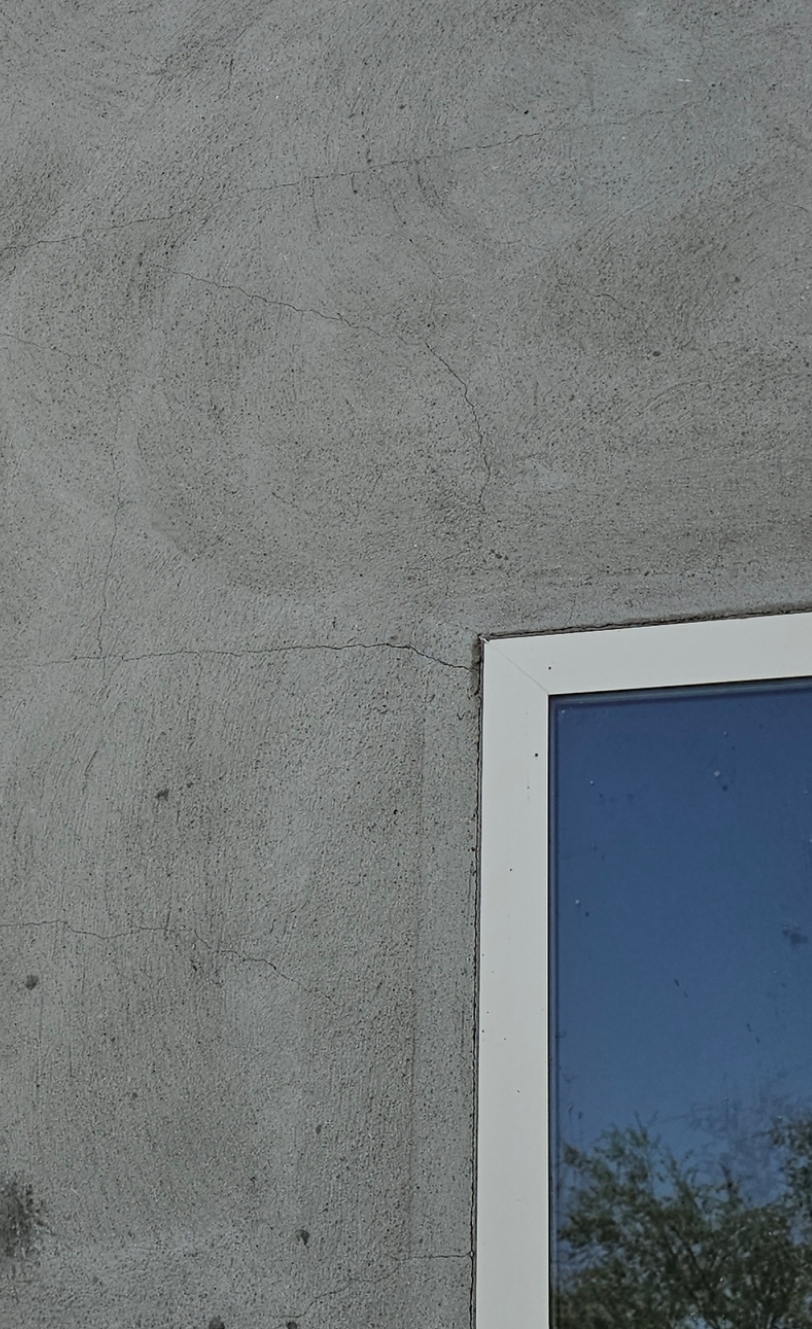
Small hairline cracks are commonly observed at control joints, corners, and other stress points and may be cosmetic. Crack location, pattern, width, displacement, moisture conditions, and whether the cracking has changed over time should all be considered when evaluating significance. The cracks that prompt closer evaluation are diagonal cracks radiating from the corners of windows and doors — especially when stepped, wide, or accompanied by similar patterns on the interior. Those can suggest differential foundation movement. We also look for areas where the stucco has delaminated from the substrate — it sounds hollow when tapped — and for horizontal cracking along wall mid-spans.
Diagonal cracking at window corners — especially when mirrored on the interior — warrants closer evaluation for differential foundation movement. Stucco also fails at penetrations: hose bibs, electrical boxes, AC line sets, and utility entries are all places where water can find its way behind the finish. We probe these areas with a moisture meter. Elevated readings may indicate moisture intrusion or retained moisture and warrant further investigation — readings can vary depending on the material, meter type, environmental conditions, and comparison readings in surrounding areas. El Paso does not get much rain — but the monsoon season brings enough intensity to exploit every gap in an otherwise dry exterior envelope.
If you see stucco cracking on a home you are considering, do not dismiss it and do not panic. Get it inspected by someone who understands the difference between cosmetic and structural. See also our supporting article on foundation inspection and engineer evaluation for homes where stucco patterns suggest movement below grade.
Foundation Movement
Foundation movement and related conditions are important considerations when inspecting homes throughout the El Paso region. The soil plays a significant role. Across the Ysleta, Clint, Socorro, and Upper Valley areas of El Paso, expansive clay soils swell when wet and shrink when dry. In the foothills and northeast, caliche layers create drainage challenges that concentrate water at the slab perimeter. Over time, this causes differential movement — one corner of the slab heaves or settles relative to the rest, and the home shows the effects throughout its structure.
The signs are not always dramatic. We look for: sticking doors and windows (doors that drag or will not latch without forcing), diagonal cracking in drywall at corners of openings, gaps between interior trim and ceilings or floors, floor slopes that a level will confirm, and exterior stucco patterns that mirror interior cracking. None of these in isolation is definitive. The pattern across the whole home tells the story.
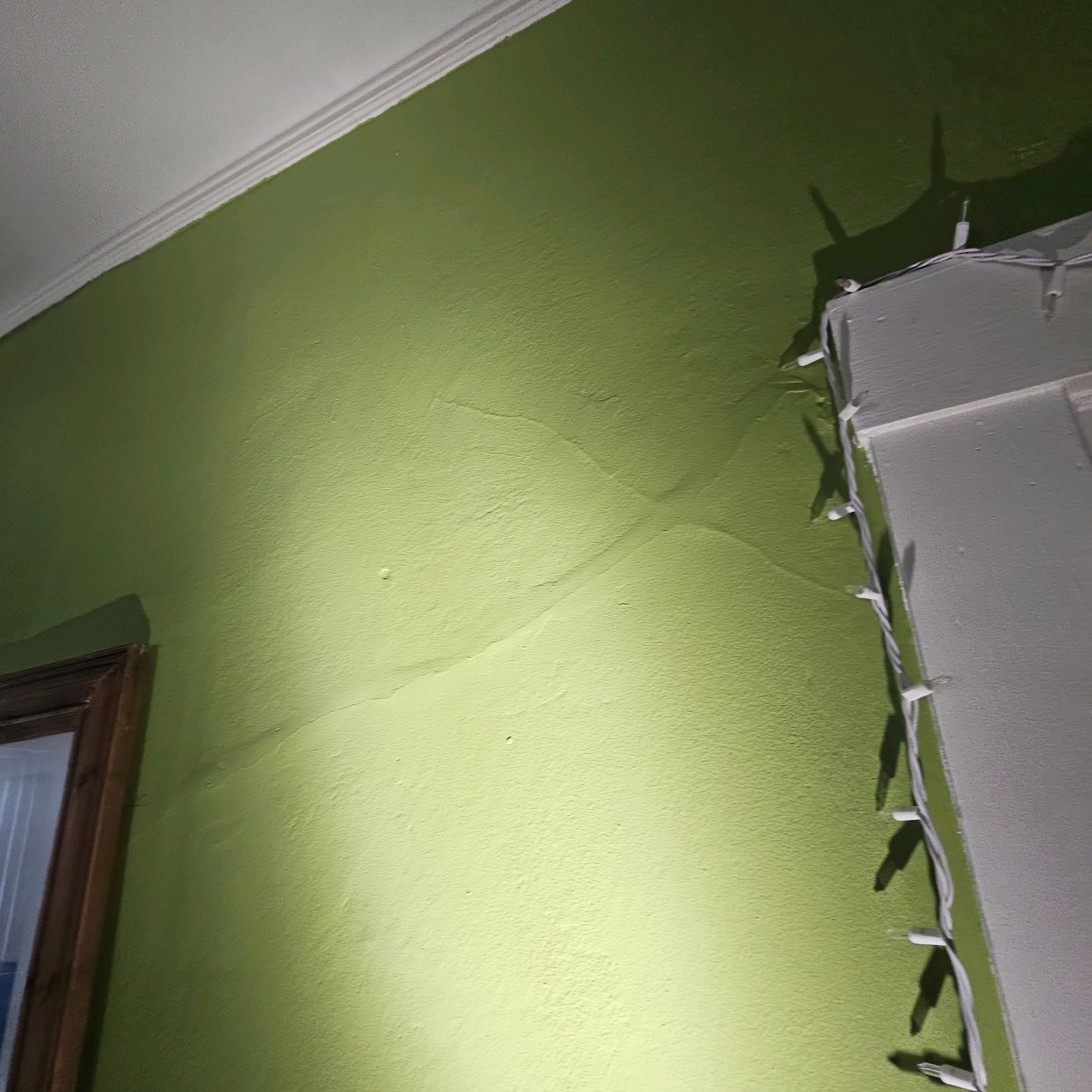
Diagonal drywall cracking at door and window corners can be associated with differential foundation movement, although cracking can have multiple causes and should be evaluated in context with other observed conditions. When we document foundation concerns, the right next step is always a licensed structural engineer evaluation — not a foundation repair company estimate. Repair companies profit from recommending repair. Engineers give you an independent analysis of whether movement is active, what is causing it, and what (if anything) needs to be done. Many foundation issues in El Paso are historical — the movement happened, the house stabilized, and the cosmetic evidence just was not repaired. An engineer can tell you which situation you are in.
Inspector Pros offers a combined foundation inspection and engineer evaluation with a licensed structural engineer. If our inspectors flag foundation concerns during a buyer's inspection, we can arrange the engineer evaluation as a same-week follow-up.
Flat and Low-Slope Roofs
Flat and low-slope roofing systems are common on homes throughout El Paso. The desert climate makes them practical — rainfall is low, and flat roofs cost less to build than pitched ones. But low-slope roofing has a different failure mode than sloped roofing, and it requires a trained eye to evaluate properly.
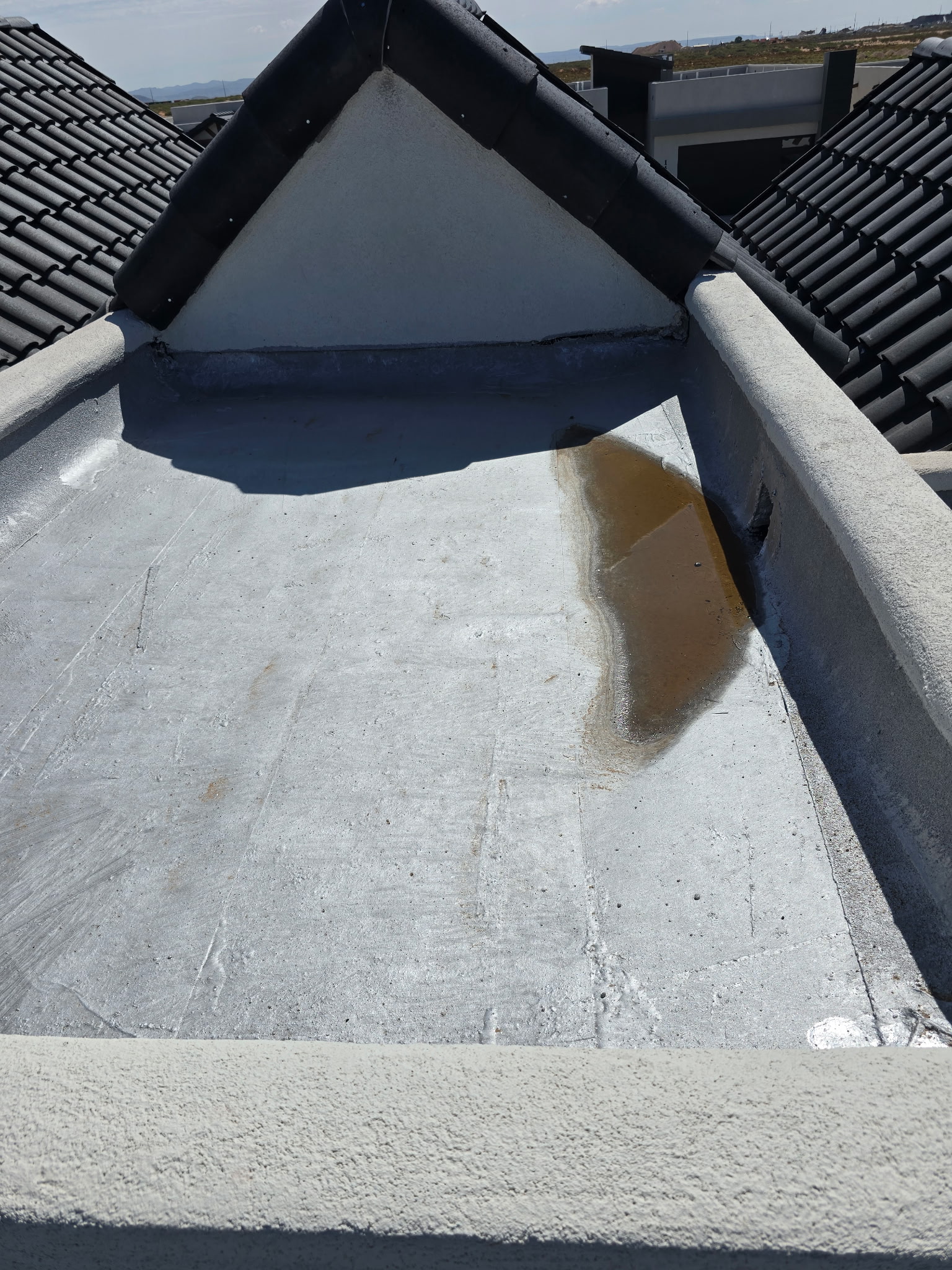
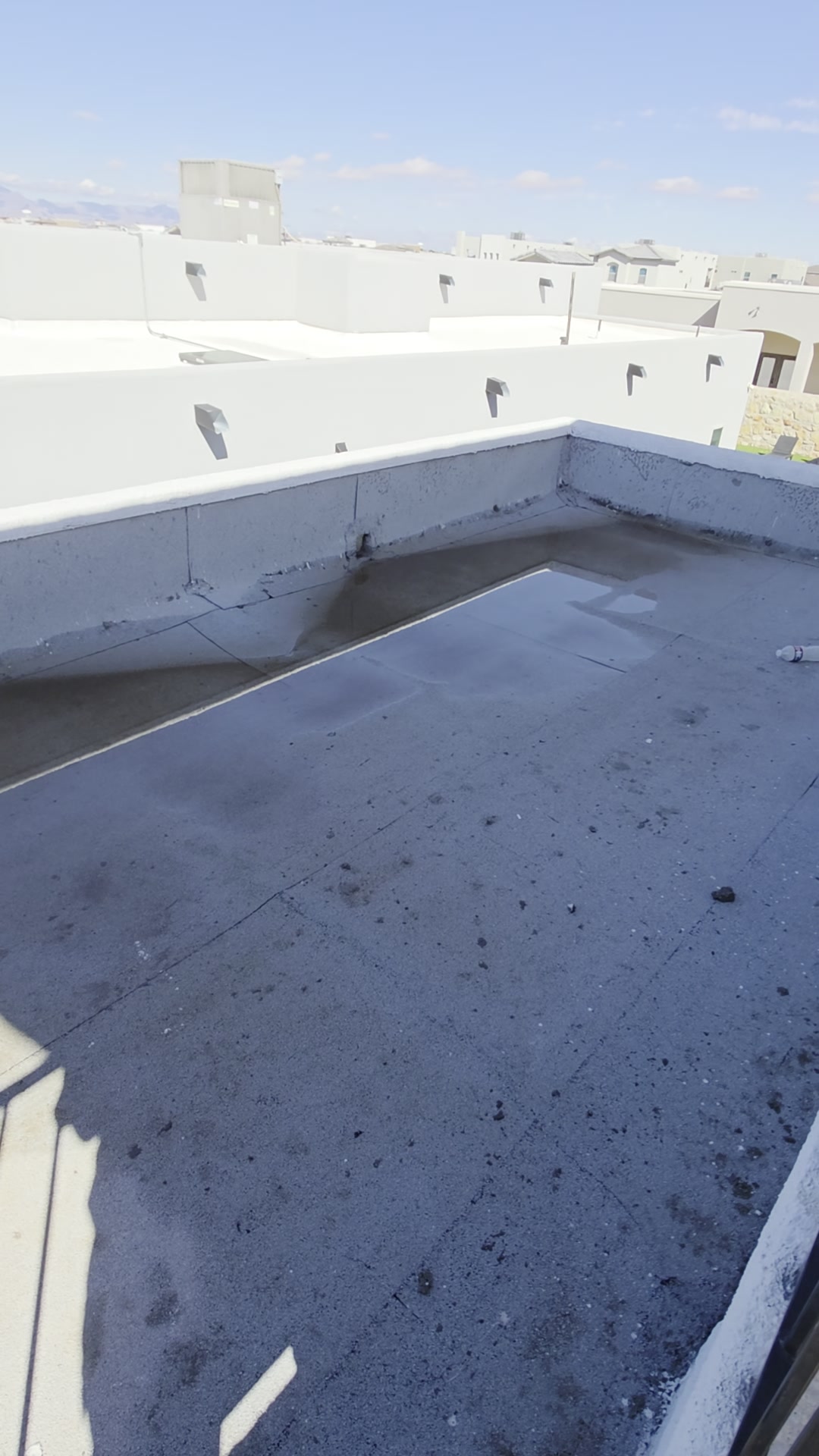
The primary issue is ponding water. Even in El Paso's dry climate, monsoon rains can dump an inch in thirty minutes. A flat roof with inadequate drainage traps that water — and water sitting on a membrane for more than 48 hours after rain is an industry-recognized sign of drainage failure. Over years, ponding degrades the roofing membrane, softens the roof deck, and eventually finds its way through. By the time you see a stain on a ceiling, the damage above it is often significant.
Ponding water on a flat or low-slope roof after rain is a drainage failure. If water sits for more than 48 hours, the membrane is being degraded with every storm.Scuppers — the through-wall openings along the parapet — are the only drainage path on most El Paso flat roofs. When they clog, sit too high, or were never cut deep enough, water has nowhere to go and ponds against the wall, exactly as shown above. We also look for: bubbling or blistering of the coating (trapped moisture beneath the surface), failed seams and lap joints where two sections of membrane overlap, deteriorated or missing flashing at parapet walls and penetrations, and cracked or dried elastomeric coating that has lost its waterproofing properties. On homes with built-up roofing (tar and gravel), we look for exposed felts, bare spots, and alligatoring — the pattern of surface cracking that looks like crocodile skin and indicates the top layer is failing.
Inspector Pros walks every roof that is safely accessible. When pitch or condition makes walking unsafe, we deploy drone inspection — giving us high-resolution aerial coverage of every surface and penetration. A flat roof that looks fine from the attic hatch can tell a completely different story from above.
HVAC Wear in Extreme Heat
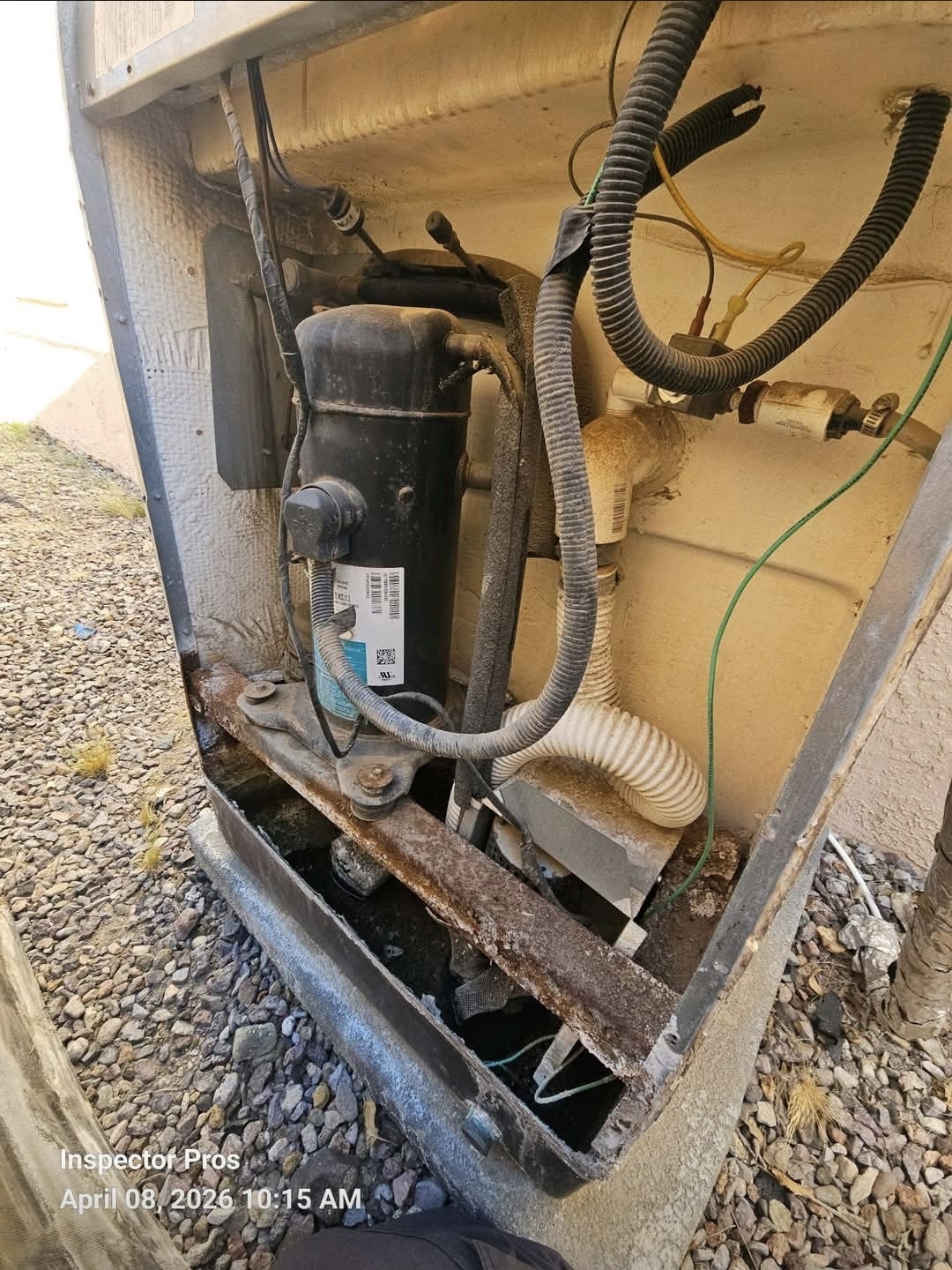
Air conditioning in El Paso is not seasonal — it is survival infrastructure. El Paso's long cooling season, high summer temperatures, and dusty conditions place significant demands on HVAC equipment — and those demands show up in how systems wear over time.
The expected service life of a central air conditioning system is generally cited as 15–20 years, though actual service life varies significantly based on equipment quality, installation, maintenance, and operating conditions. El Paso's long cooling season, high summer temperatures, dust, and heavy system use can place significant demands on HVAC equipment. We note equipment age, observed condition, and operational performance on every HVAC component in our reports — and we flag systems where age combined with observed condition suggests limited remaining useful life.
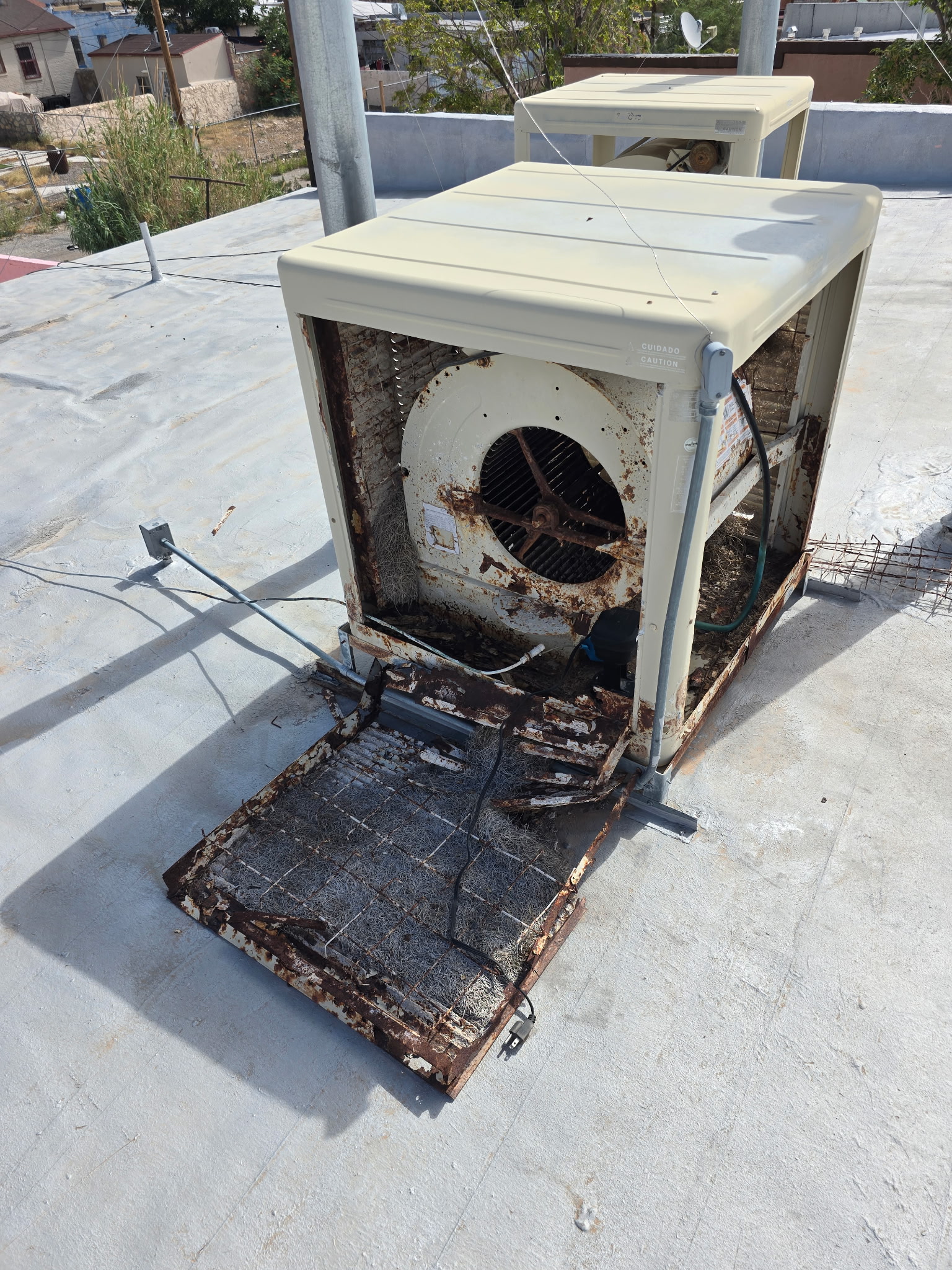
This condenser unit is past its expected service life. In El Paso's climate, an aging HVAC system is not a deferred maintenance item — it is a near-term capital expense. Evaporative coolers — swamp coolers — are common on older El Paso homes, particularly in central and east El Paso neighborhoods built before the 1980s. They are inexpensive to operate but require more maintenance than refrigerated air: pad replacement, pump service, and water line winterization are annual needs. We evaluate evaporative coolers on their own terms — checking the pump, pads, float valve, distribution lines, and housing condition — and note whether the home has dual-system setup (refrigerated backup for the humid monsoon months when evaporative cooling loses effectiveness).
Evaporative cooler pads should be replaced annually. Mineral-encrusted pads restrict airflow and reduce cooling efficiency significantly — a commonly deferred maintenance item. Ductwork is another HVAC issue unique to desert climates. Attic temperatures in El Paso can exceed 150°F in summer. Duct insulation that has deteriorated, compressed, or been improperly installed creates significant energy loss — the conditioned air you are paying to cool heats back up before it reaches the living space. We inspect attic ductwork condition, insulation, and sealing on every inspection.
Hard Water Damage
El Paso's hard, mineral-rich water carries a significant load of calcium and magnesium — primarily calcium and magnesium — that deposits inside pipes, fixtures, and water heaters over time. Most buyers from out of state are unprepared for how significant this is. The effects are visible, measurable, and costly.
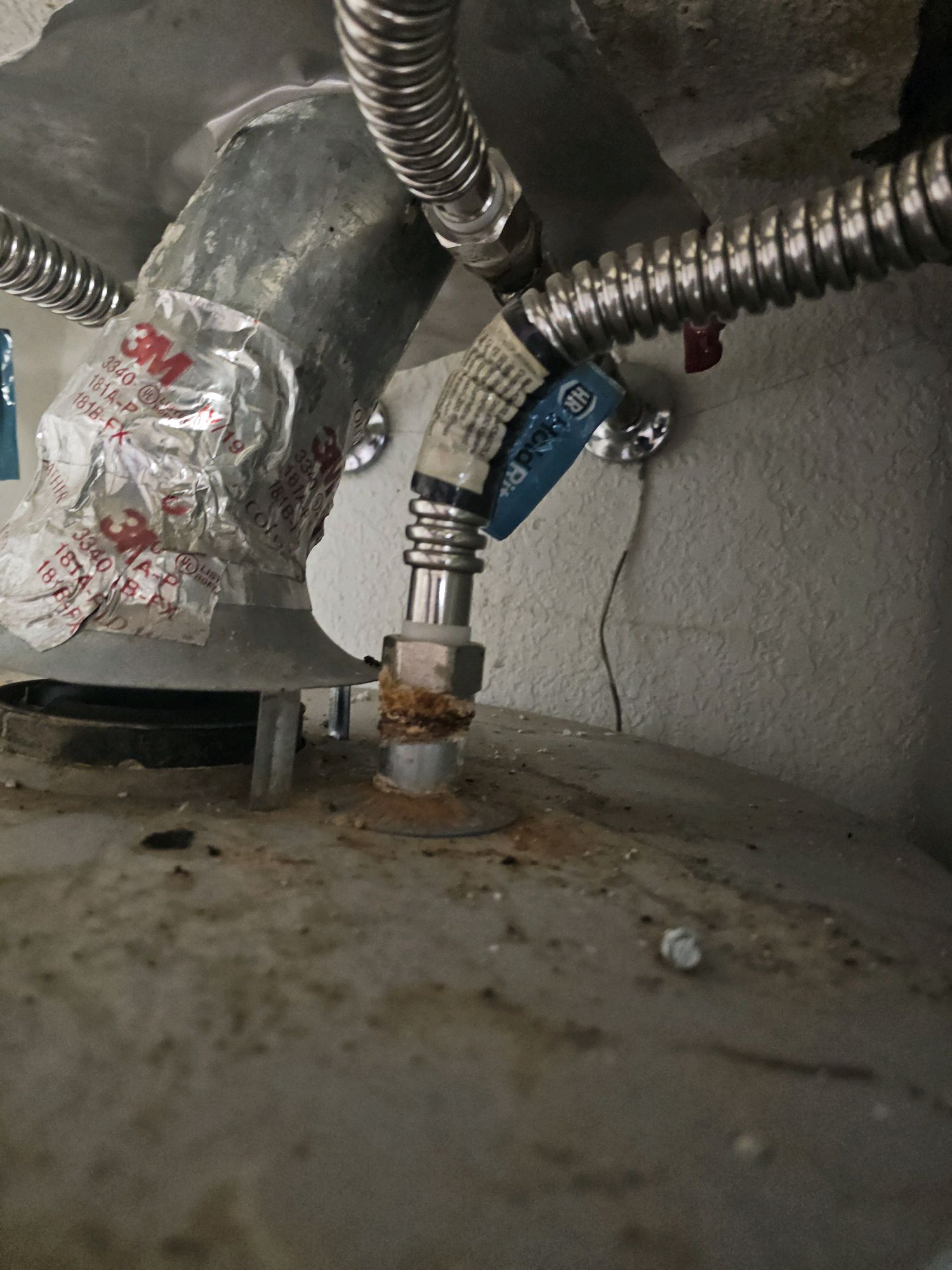
Water heaters are the most commonly affected appliance. Sediment — the mineral scale that settles to the bottom of the tank — insulates the heat element from the water, forcing the heater to work harder and longer to achieve the same temperature. El Paso's mineral-rich water can contribute to scale and sediment accumulation inside water heaters and on plumbing fixtures. The amount of accumulation varies based on water conditions, equipment design, age, temperature settings, maintenance, and usage. We evaluate water heater age, condition, and whether the anode rod — the sacrificial element that prevents tank corrosion — has been maintained.
The calcium deposit visible at the pressure relief valve and connections is a reliable indicator of hard water scale buildup inside this water heater. Annual flushing extends service life — most El Paso homeowners never do it. Scale also accumulates inside supply pipes. On homes with galvanized steel supply lines — common in central El Paso homes built in the 1950s through 1970s — the interior of the pipe is progressively reduced by mineral buildup until water pressure at fixtures becomes noticeably degraded. We test flow at multiple fixtures and note any pressure anomalies that suggest restricted supply lines. A home with galvanized plumbing and hard water is a home with an unknown pipe condition that a camera inspection can clarify.
Fixtures accumulate visible scale at aerators, shower heads, and around faucet bases. This is cosmetic but tells you something about the water chemistry the home has been subjected to. We also check under sinks for evidence of past supply line failures — which in El Paso often happen at the braided stainless connectors that corrode at the fitting ends from mineral interaction.
Sewer Line Issues
The sewer lateral — the pipe that runs from the home to the city main — is the most expensive plumbing problem most homeowners will ever face, and it is almost never visible during a standard home inspection. In established El Paso neighborhoods like Kern Place, Mission Hills, Five Points, and Sunset Heights, homes were built in the 1940s through 1960s with clay tile or cast iron sewer laterals. Those pipes are now 60–80 years old, and many are at or past the end of their service life.
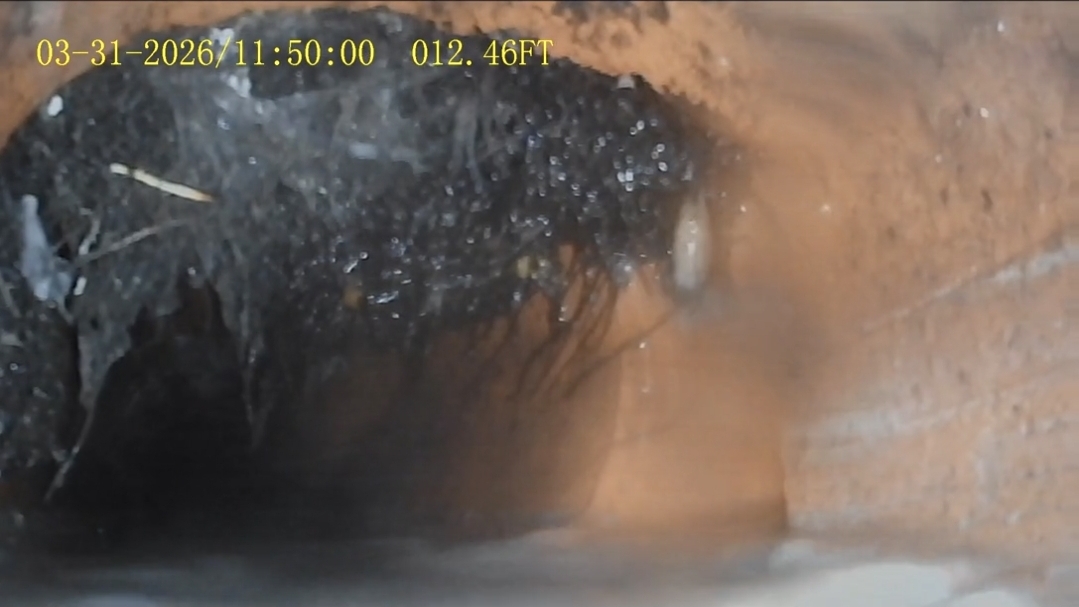
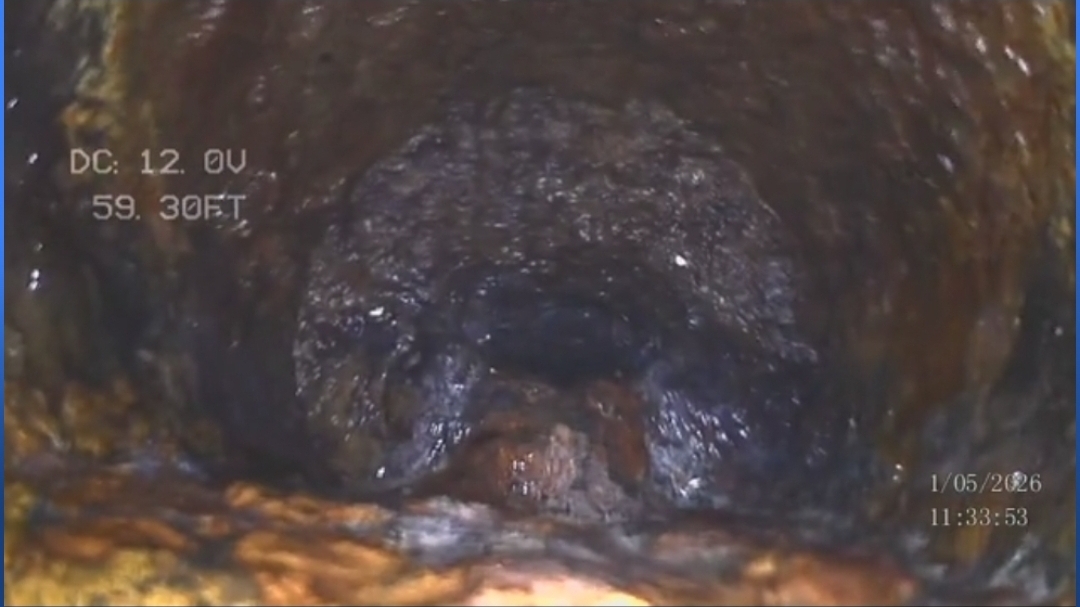
Clay tile pipe joints allow root intrusion — tree roots find the moisture at the joint, enter the pipe, and eventually block or break it. Cast iron corrodes from the inside out. In some cases, we find pipes that have completely collapsed and are being held together only by the surrounding soil. None of this is visible without a camera.
Root intrusion captured on a sewer scope camera. The roots have entered through a clay tile joint and are beginning to block the flow channel. Left unaddressed, this becomes a full obstruction — and an emergency on moving day. Cast iron pipe deteriorating from the inside out — the pipe wall is compromised. A standard visual inspection would never reveal this condition. Significant sewer-lateral defects can result in costly repairs that may not be apparent until they fail. Inspector Pros offers a sewer scope inspection as an add-on to any buyer's inspection. During a sewer scope, a camera is advanced through the accessible sewer lateral as far as access and conditions allow. The camera footage is recorded and included with your inspection report. We note pipe material, condition, any root intrusion, offset joints, and flow characteristics within the inspected portion of the line. For any home built before 1980, we strongly recommend adding the sewer scope — the cost is modest; the downside of skipping it is not.
Termites
Texas is home to multiple termite species, and El Paso properties can be affected by both subterranean and drywood termites. Understanding what indicators each type leaves helps explain what inspectors look for during a wood-destroying insect (WDI) inspection.
Subterranean termites live in the soil and require ground contact to access wood. Potential indicators include shelter tubes (mud tubes) running along foundation walls, piers, or other surfaces from soil to wood; wood-to-soil contact conditions that create conducive entry points; damaged or hollow-sounding wood; and moisture-conducive conditions around the foundation or at penetrations. Subterranean termites are present throughout Texas and should always be considered during a termite inspection.
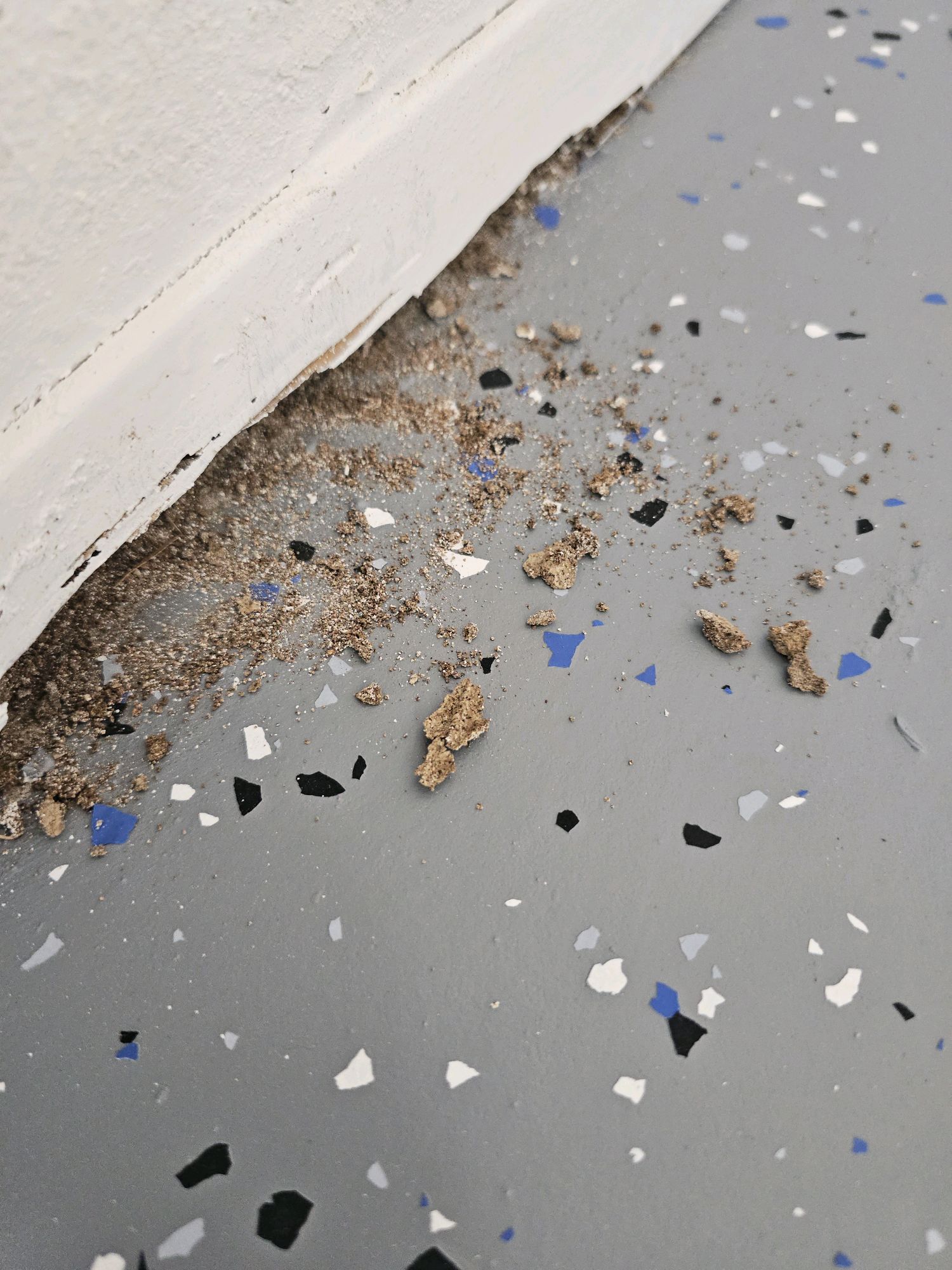
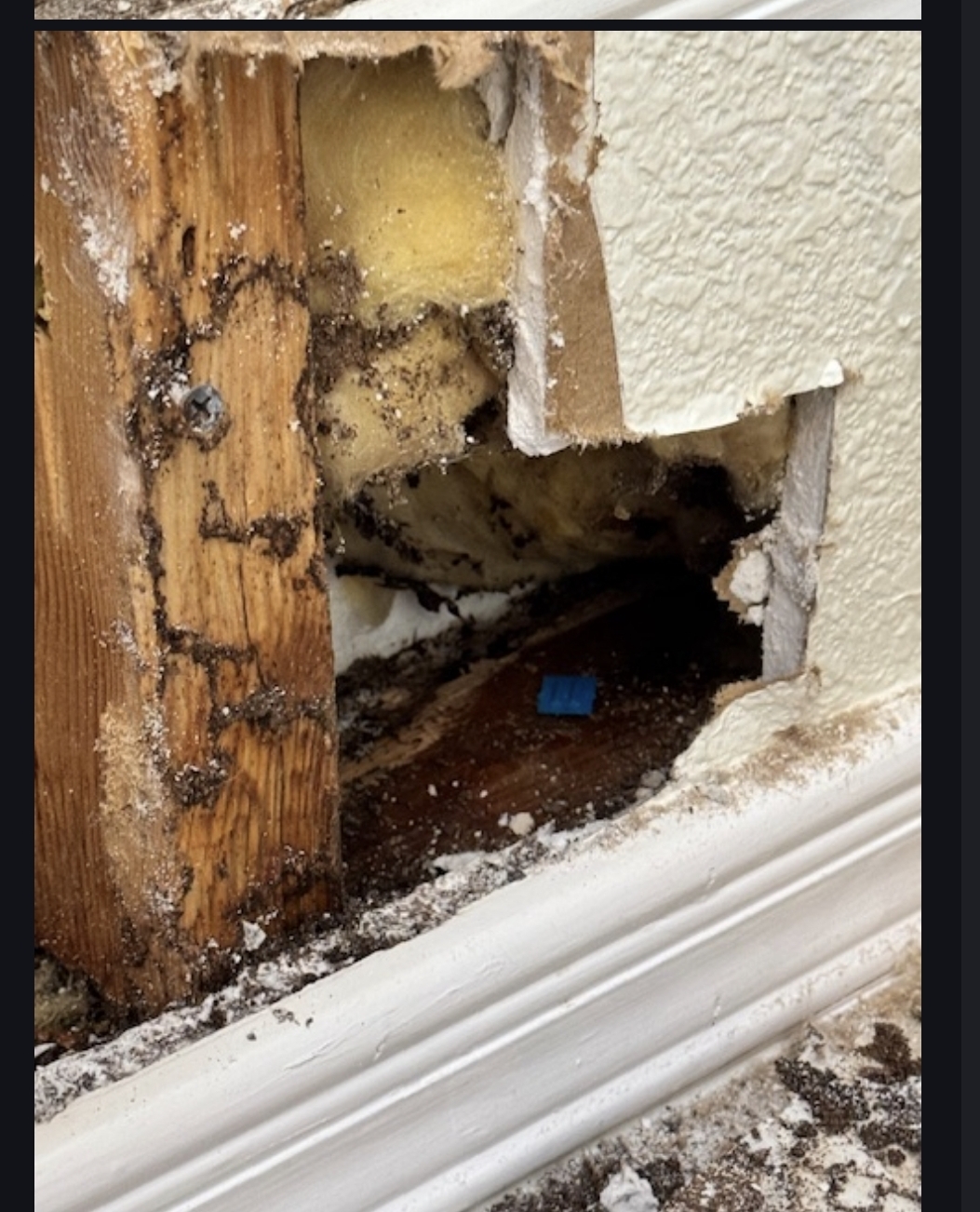
Drywood termites colonize wood directly without soil contact. They are less common than subterranean termites but are encountered in the El Paso area. Evidence includes frass — tiny, pellet-shaped excrement that accumulates beneath infested wood — and kick-out holes in wood surfaces where the colony ejects frass. We look for frass at windowsills, door frames, attic framing, and anywhere structural wood is exposed.
Drywood termite frass — the tiny, pellet-shaped excrement colonies push out through kick holes — found at a windowsill. This indicates an active colony somewhere above this location in the frame. Interior termite galleries in a structural wood member. The surface appeared intact — the damage was discovered by probing. Drywood termites hollow wood from the inside, leaving a paper-thin shell. Active termite infestation and past damage are two different findings with different implications. An active colony needs treatment. Past damage — wood that was treated but left structurally compromised — needs repair. We probe suspected wood with a screwdriver or pick to assess whether damage has reduced structural integrity. Inspector Pros is TDA licensed for termite and WDI inspections. See our termite and WDI inspection service page for details on what a formal Wood Destroying Insect report covers and when your lender requires one.
Electrical in Older Homes
El Paso has a lot of homes built between the 1940s and 1980s, and the electrical systems in those homes reflect the standards — and limitations — of their era. We find three categories of electrical concern repeatedly in this housing stock.
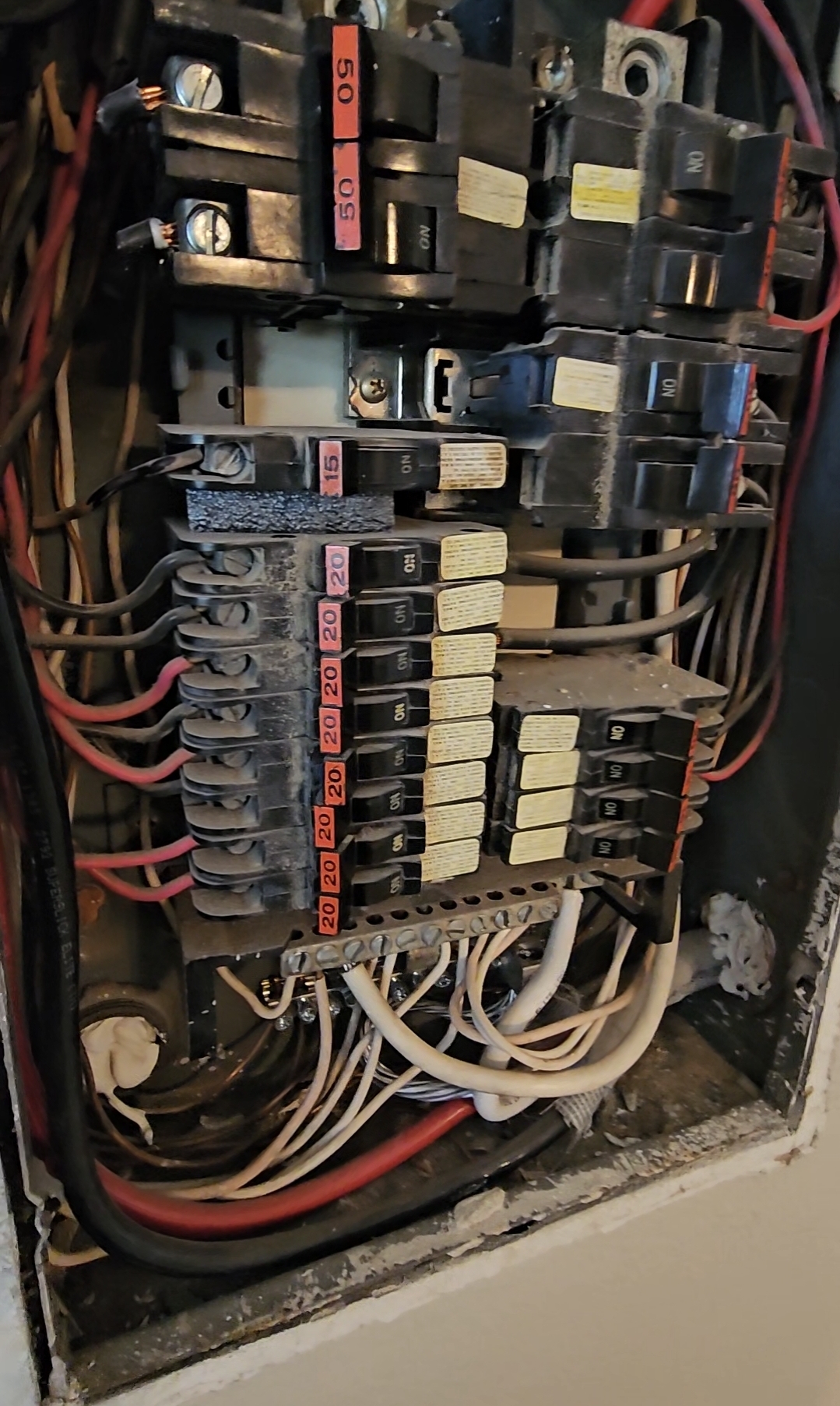
The first is panel issues. Federal Pacific Electric (FPE) Stab-Lok panels were installed widely in the 1960s and 1970s and have a documented history of breakers that fail to trip under overload conditions — a fire hazard. We still find these in El Paso homes. Zinsco panels, also from this era, have similar documented breaker failure concerns. Neither is code-compliant to install today. When these panels are identified during an inspection, further evaluation by a licensed electrician is recommended to determine appropriate corrective action.
A Federal Pacific Stab-Lok panel — identified by the distinctive red breakers and the Stab-Lok name. These have a documented history of breaker failure under overload. Further evaluation by a licensed electrician is recommended when these panels are identified. The second is aluminum branch circuit wiring. In the mid-1960s through 1970s, aluminum wire was used for 15- and 20-amp branch circuits as a less expensive alternative to copper. Aluminum expands and contracts more than copper with heat cycles, causing connections at outlets and switches to loosen over time. Loose connections arc. Arcing starts fires. If we find aluminum branch circuit wiring, we look for CO/ALR rated devices at every outlet and switch, and we recommend evaluation by a licensed electrician. This is a manageable problem with proper remediation — but it needs to be addressed.
The third is the absence of GFCI protection at wet locations. Ground fault circuit interrupter protection at kitchen countertops, bathrooms, garage, exterior outlets, and near pools became required by code at different points over the decades. Older homes often lack it entirely. GFCI outlets are inexpensive to install — but the absence of them is a safety finding we document every time.
Window Failures
El Paso's temperature swings are extreme — 110°F in summer, below freezing on winter nights. That thermal cycling is hard on insulated glass units (IGUs), which are the double-pane sealed assemblies in modern windows. The seal between the two panes is designed to hold an insulating gas (typically argon) in the cavity and prevent moisture infiltration. When that seal fails, the window fogs between the panes — permanently. No amount of cleaning fixes it.
Seal failure does not make a window stop functioning as a window. It does eliminate the insulating value of the double-pane assembly and turn it into the equivalent of a single-pane unit. In El Paso's climate, where HVAC is running hard for most of the year, failed window seals translate directly to energy loss and higher utility bills. We note failed seals throughout the inspection and include them in our report.
Fogging between the glass panes is the unmistakable sign of a failed IGU seal. The insulating gas has escaped; moisture has entered. In El Paso, multiple failed seals in a home is an energy cost issue worth pricing into your offer. Homes built in the 1960s and 1970s often still have their original single-pane aluminum frame windows. These have no insulating value to lose — they conduct heat directly. We note single-pane windows as an energy efficiency item, particularly in homes where the buyer is asking about utility costs.
New Construction Is Not Immune
One of the most persistent misconceptions in real estate is that new construction homes do not need inspections. They have passed city inspections. They have builder warranties. What could go wrong? In our experience: quite a bit.
City code inspections are brief and focused on minimum code compliance — not on quality of workmanship. Subcontractors work under time pressure on production builds. Common findings on new construction in El Paso and Horizon City include: missing or inadequate attic insulation (especially relevant in a climate that puts extreme demand on HVAC), improperly supported HVAC ductwork that sags and restricts airflow, missing GFCI protection at required locations, grading that channels water toward rather than away from the foundation, roof flashing gaps at valleys and penetrations, and incomplete caulking at exterior wall penetrations.
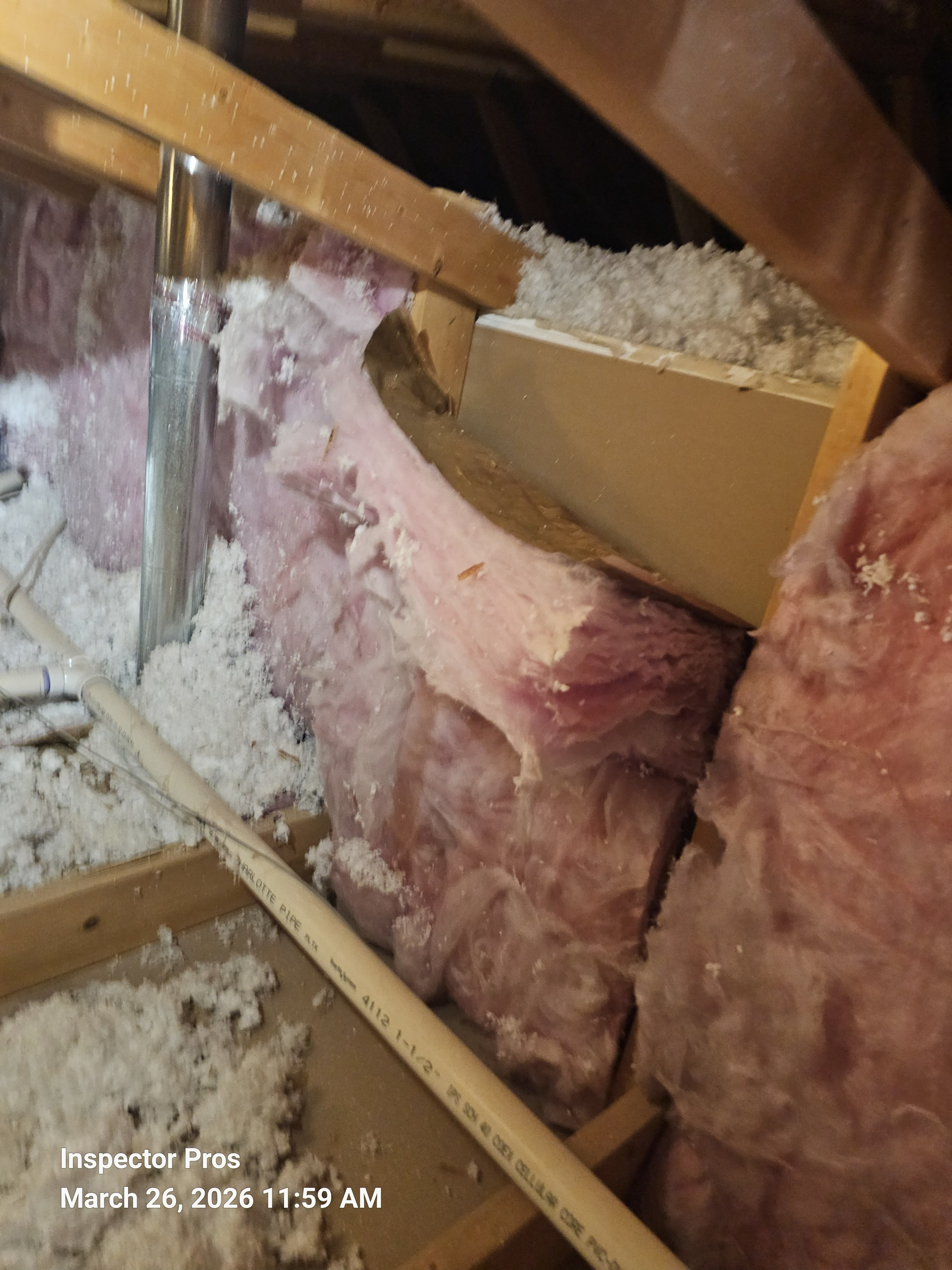
Missing insulation at an attic knee wall in a new construction home in Horizon City. The city inspection passed. The gap went straight to the exterior — pure thermal bypass in a climate that demands every bit of insulation you can get. Missing flashing at a roof penetration on a home that was weeks from closing. The city inspection did not catch it. The first monsoon rain would have found it the hard way. Inspector Pros performs new construction inspections including pre-drywall inspections — the only time you can see inside the walls before they are permanently closed. We hold ICC certification #8211646, which gives our inspectors deep knowledge of construction standards that goes beyond general inspection training.
Pools
El Paso's climate makes pools one of the more desirable features in a home — and one of the more consequential items to evaluate before purchase. A pool is a significant mechanical system, not just a concrete hole with water in it, and the inspection scope is distinct from a general home inspection.
Pool inspections cover the shell for cracks, spalling, and delamination of the finish coat. They cover the equipment pad — the pump, motor, filter, heater, and any automation systems. They cover the electrical systems serving the pool, including bonding and GFCI protection at the equipment. They cover the deck surface for cracking, lifting, and proper drainage away from the shell. And they cover the barrier — fencing, gate latches, and self-closing mechanisms required for pool safety compliance.
El Paso's hard water affects pools the same way it affects everything else — calcium scale builds up on the shell, tile line, and equipment. Pools that have not been properly maintained and chemically treated show heavy scale deposits that can obscure shell condition and damage tile grout. Aged pool equipment — pumps and heaters running on hard water for 15+ years — often shows significant internal deterioration that a visual inspection may not fully capture.
A pool inspection is a separate service from the general home inspection and requires additional time on-site. See our pool inspection service for what is covered and why adding it when purchasing a home with a pool is not optional.
Solar Panel Systems
Solar adoption in El Paso has accelerated rapidly — and understandably so. With 300+ sunny days per year and high electricity rates, the economics of solar here are genuinely favorable. But a solar panel system is a significant installation that adds complexity to a home inspection, and it is one area where we see buyers rely too heavily on the seller's word rather than independent documentation.
When we inspect a home with a solar installation, we evaluate the roof penetrations and flashing — because every roof mount is a potential leak point, and we have seen installations where the flashing was done improperly and the homeowner did not know until a monsoon revealed it. We note panel condition, visible wiring, and the condition of the racking system. We also document whether the system is owned or leased, because a solar lease transfers with the home — and inheriting a 20-year lease payment has real financial implications for the buyer.
We do not perform system-level electrical testing of the inverter, production metering, or panel output — that requires specialized solar equipment and a solar technician. What we do is evaluate what a licensed inspector can evaluate: the physical installation, roof interface, and visible electrical components. We can tell you whether the installation looks correct; whether it is producing at rated output requires a specialist. For homes where the solar system is a significant factor in the purchase decision, we recommend asking the seller for the production history from the monitoring system and having a solar technician verify system performance before closing.
Every home on this list has problems. Every home you will ever buy will have problems. The goal of a home inspection is not to find a perfect home — it does not exist. The goal is to walk into closing with complete information: what you are buying, what it will need, and what it might cost. Armed with that, you can negotiate intelligently, plan your budget, and make a confident decision rather than discovering these things after the keys are in your hand.
The inspector's job — our job — is to find these things and communicate them clearly. The buyer's job is to decide what to do with that information. We make sure you have it.
If you are buying a home in El Paso, Horizon City, Las Cruces, or anywhere in the surrounding region, Inspector Pros offers same-week scheduling seven days a week. Both founders are Certified Master Inspectors — the highest credential in the industry — and we include infrared thermal imaging on every inspection at no extra charge. Schedule your inspection online or call us at (915) 209-2332.
Frequently Asked Questions
What are the most common problems found in El Paso homes?
The most common issues in El Paso homes include stucco cracking from thermal cycling and foundation movement, flat and low-slope roof failures, HVAC systems aged prematurely by extreme heat, hard water damage to plumbing and water heaters, aging sewer laterals in older neighborhoods, termites and wood-destroying insects, and electrical systems in homes built before 1980. Foundation concerns are especially common due to expansive clay soils in parts of the city.
Do El Paso homes have foundation problems?
Foundation movement and related conditions are an important consideration when inspecting homes throughout the El Paso region. Expansive clay soils found in areas like Ysleta, Clint, Socorro, and the Upper Valley can swell and shrink with moisture changes. Caliche layers in the northeast can affect drainage around foundations. When our inspectors flag foundation concerns, we recommend a licensed structural engineer evaluation to determine whether movement is active and what — if anything — needs to be done.
What kind of termites are found in El Paso TX?
Both subterranean and drywood termites may be encountered in the El Paso region. Subterranean termites typically travel between the soil and wood and may produce shelter tubes, while drywood termites can infest wood without soil contact and may leave characteristic pellets or frass. A Texas WDI inspection evaluates visible and accessible areas for evidence of wood-destroying insects and conducive conditions. Inspector Pros is TDA licensed for termite and WDI inspections.
Is hard water a problem for El Paso homes?
Yes. El Paso's hard, mineral-rich water can contribute to scale and mineral accumulation inside water heaters, supply pipes, fixtures, and pool equipment over time. Water heaters that are not regularly flushed can accumulate sediment that reduces efficiency and affects service life. We evaluate water heater age and condition on every inspection.
Should I get a sewer scope inspection on an older El Paso home?
Yes — strongly recommended. Established El Paso neighborhoods built before 1980 commonly have clay tile or cast iron sewer laterals that are now 50–80 years old. These pipes are prone to root intrusion, joint offset, and corrosion that a standard visual inspection cannot detect. During a sewer scope, a camera is advanced through the accessible lateral as far as access and conditions allow, identifying visible conditions such as root intrusion, offsets, deterioration, or restrictions within the inspected portion. For any home built before 1980, the sewer scope is worth adding.
How does El Paso's climate affect HVAC systems?
El Paso's long cooling season, high summer temperatures, dust, and heavy system use can place significant demands on HVAC equipment. Actual service life varies based on equipment quality, installation, maintenance, operating conditions, and usage. We note equipment age and observed operational condition on every HVAC component and flag systems where age combined with observed condition suggests limited remaining useful life.
Ready to Book?
Schedule Your El Paso Home Inspection
Same-week availability, 7 days a week. Same-day reports.